Marketing Strategy
ChatGPT Is the New Neighbor. Does It Know Your Name?


For a long time, the best marketing a service business could get was a neighbor leaning over the fence. Somebody admired a clean driveway or a freshly cut lawn, asked who did it, and walked away with your name and number. That recommendation was worth more than any flyer, because it came from someone they trusted.
That conversation still happens, but more and more of it is happening on a phone. A homeowner opens ChatGPT or Gemini and types, "Who's a good pressure washing company near me that does driveways?" The AI answers with three or four names and a one-line reason for each, and they call one of them.
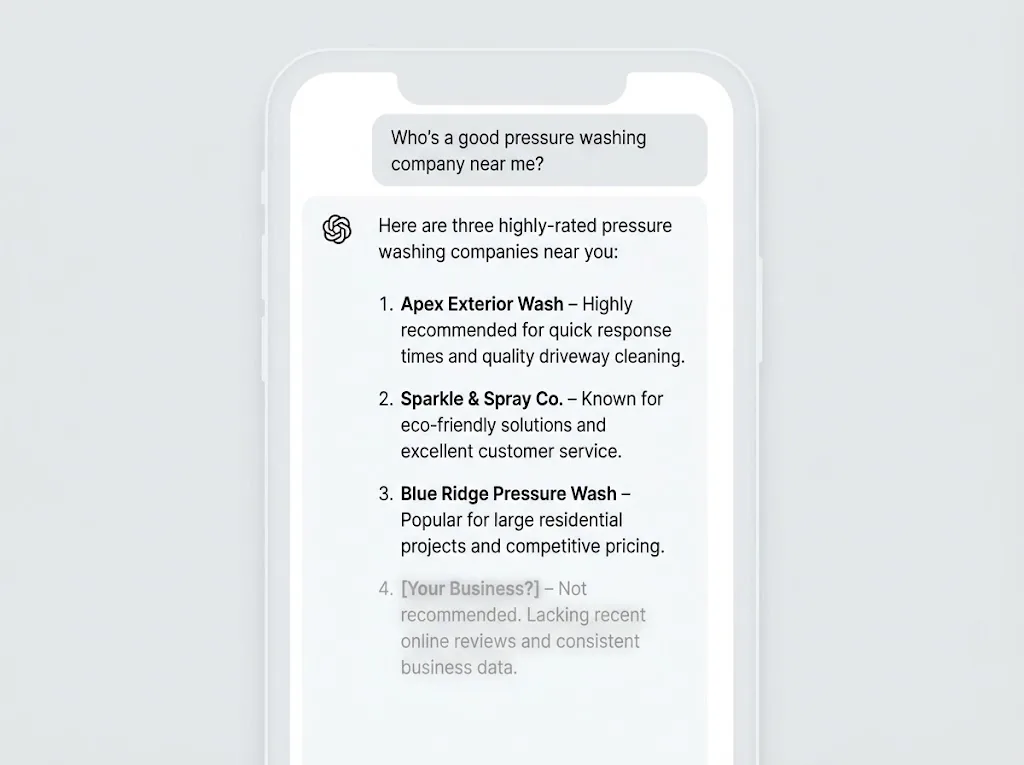
Here's the catch. This new neighbor has never seen your work. It only knows what's written about you online. If that information is thin, outdated, or scattered, you don't make the list, and you never find out you lost the job. There's no missed call and no "we went with someone else" text. The customer just never knew you existed.
Google is still where most local searches start, and it isn't going anywhere. But AI is climbing faster than anything I've seen. In BrightLocal's 2026 Local Consumer Review Survey, the share of people using ChatGPT and other AI tools for local business recommendations jumped from 6% to 45% in one year. That makes AI the third most common source of business recommendations, behind only Google and Facebook.
And people aren't just asking out of curiosity. In Yext's 2026 survey of 3,848 consumers, 28% said they had tried a new local business in the past six months specifically because an AI recommended it.
So when I say the neighbor moved onto the phone, I mean it. Your next customer might ask Google, ChatGPT, or both before they ever pick up the phone to call anyone.
On Google, there's a page of results and a map with three businesses at the top. That's already competitive. AI is tighter. It usually names a handful of businesses and stops.
SOCi's 2026 Local Visibility Index looked at roughly 350,000 business locations and found that ChatGPT recommended just 1.2% of them, compared with the 35.9% that showed up in Google's top three map results. Gemini recommended 11%.
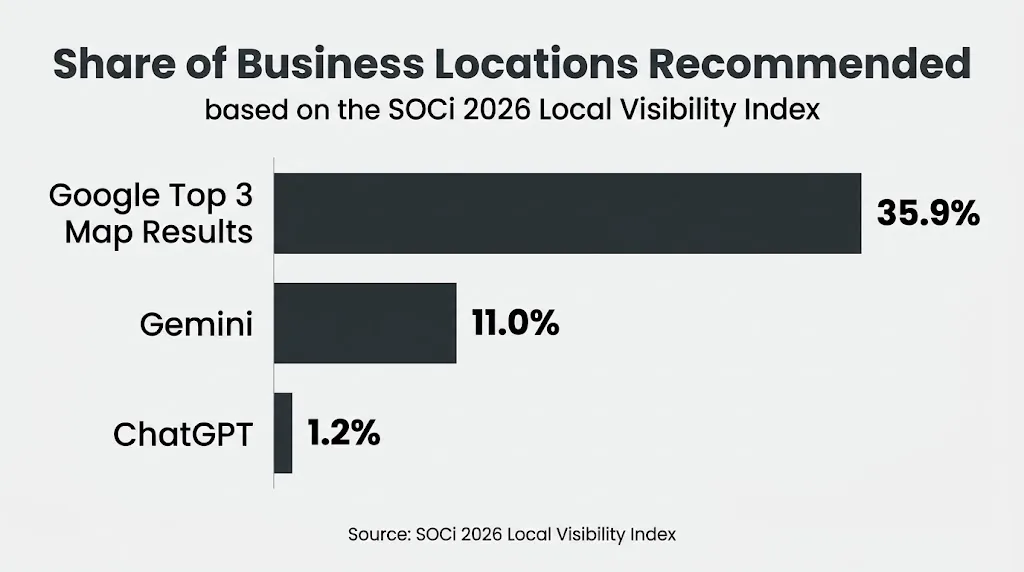
One honest note: SOCi studied larger brands with multiple locations, not one-truck operations, so your exact odds will look different. But the direction is clear. Getting named by AI is a lot harder than showing up on Google, and the businesses that do get named are picking up customers everyone else never even sees.
AI doesn't drive around town looking at driveways. When someone asks ChatGPT a local question, OpenAI says it searches the web and can use the person's location to find local results. Then it reads what it finds: your website, your Google Business Profile, your reviews, directories like Yelp and the BBB, and any local articles or lists that mention you.
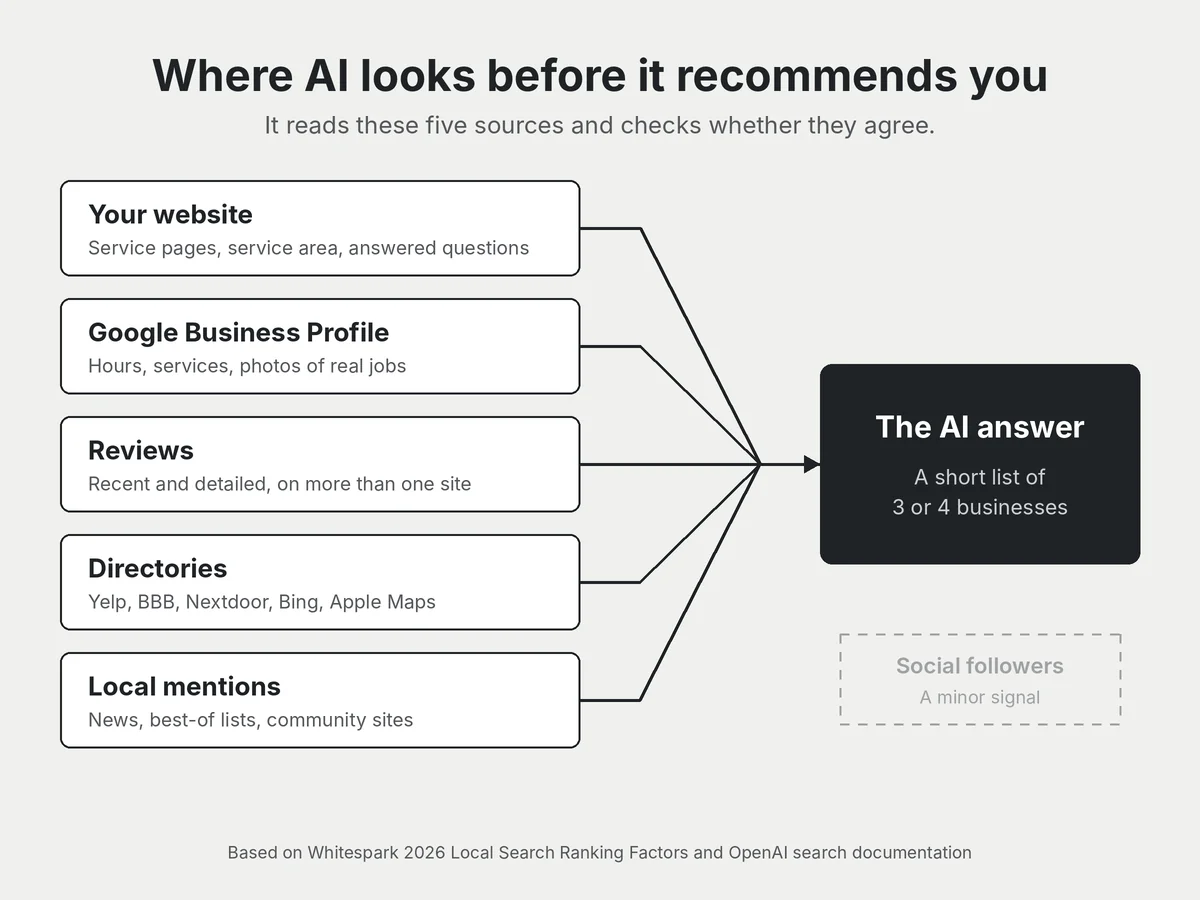
It also checks those sources against each other. If your website lists one phone number, your Google profile lists another, and an old directory still has a third, the AI has less reason to trust any of them. That's how a business ends up described wrong, or left out entirely.
Reviews carry a lot of weight too, and not just the star rating. Google's own help pages say more reviews and positive ratings can help your local ranking, and Gemini pulls its local answers from those same Google results. Customers check, too. Among people who use AI for local recommendations, 97% double-check the answer against real reviews.
Think of your Instagram as the wrap on your work truck. It gets you noticed by people who already follow you or happen to scroll past. It does very little to put you on the short list when a stranger searches.
Whitespark's 2026 Local Search Ranking Factors report asked 47 local search experts to score 187 things that affect where a business shows up. Follower count on social profiles ranked 186th out of 187 for Google Maps rankings. A dedicated page on your website for each service ranked number one for local organic results. Those rankings are expert opinion, not Google's internal data, but when the people who do this for a living agree that strongly, I pay attention.
Social still matters. Fresh posts show you're active and open for business, and those same experts gave social signals some weight in AI answers. It's just the supporting act, not the headliner.
None of this takes a marketing degree. Most of it comes down to making sure the information about your business is complete, current, and the same everywhere it shows up.
Grab your phone and try this:
If you didn't show up, or the AI got your details wrong, that's not a reason to panic. It's a to-do list. Every one of those gaps is fixable, and fixing them helps you on Google and in AI at the same time. If you run a pressure washing, lawn care, or maintenance company, here's how we handle marketing for home service businesses.
Work with us
Want me to run it with you?
Book a free 15-minute call. We'll run those searches together, see where you show up and where you don't, and I'll tell you what I'd fix first. No pressure and no long pitch, just an honest look.
Book a 15-minute callWant a deeper look at your whole online presence? That's what our $450 audit is for.
Yes. In BrightLocal's 2026 survey, 45% of consumers used AI tools for local business recommendations, up from 6% the year before. That makes AI the third most common source of recommendations, behind Google and Facebook.
It searches the web, uses the person's location, and reads what it finds: your website, Google Business Profile, reviews, directories, and local mentions. It also checks whether those sources agree, so matching contact info everywhere matters.
Not much on its own. In Whitespark's 2026 survey of local search experts, social follower count ranked 186th of 187 factors for Google Maps rankings. Social helps show you're active, but your website and Google profile do the heavy lifting.
It's one of the main things AI reads about your business. A site with a page for each service and your service area written out gives Google and AI something specific to match to a customer's question.
Ask ChatGPT and Gemini "Who's the best [your service] in [your town]?" and "What do you know about [your business name]?" Then compare what they say against your real phone number, services, service area, and hours.
Not sure where your marketing is leaking?
Book a callKJ Williams is the founder and Managing Director of The Influence Network, a digital marketing studio in Atlanta. Before TIN, he spent three years in marketing at CLASS-LLC. He writes about the parts of marketing most businesses skip: funnels, follow-up, and knowing which number to fix first.

A digital marketing studio in Atlanta. We find where your marketing is leaking, then build the plan, the content, and the funnel to fix it.