Why Your Marketing Funnel Is Broken in the Middle


You post consistently. The reach is good, the saves are good, and people tell you at events that they love your stuff. And your inbox is quiet.
That is not a content problem. It is a funnel problem, and it is the most common one in small business marketing.
Here is what a marketing funnel actually is, where yours is probably broken, and how to find out for certain in about twenty minutes.
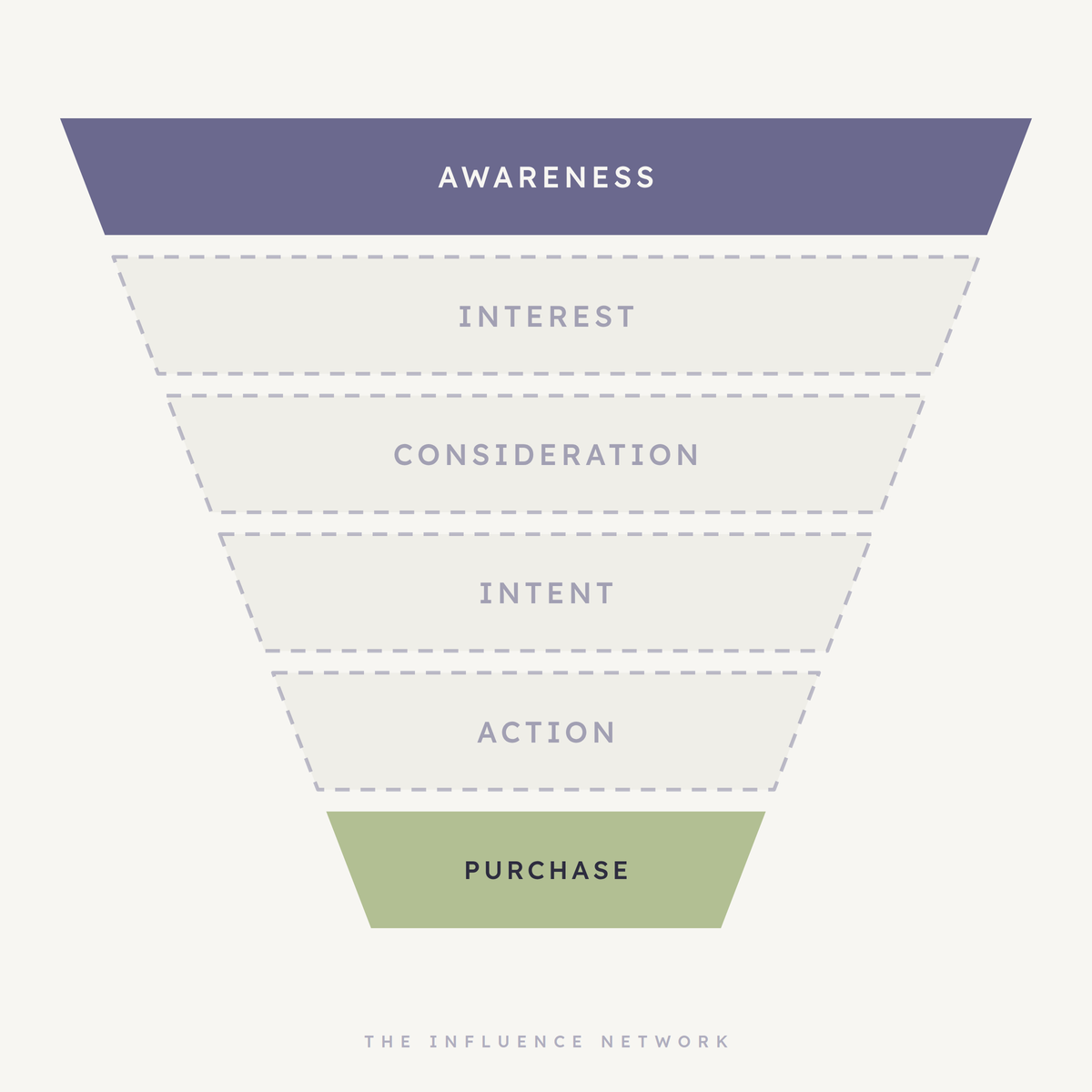
A marketing funnel is the path from "never heard of you" to "paying you, and telling other people to pay you." It gets drawn as a funnel because the numbers shrink at every step.
Ten thousand people see a video. Four hundred visit your profile. Thirty click the link. Six reach out. Two hire you.
That shrinking is the entire value of the model. It turns a vague feeling that marketing is not working into a specific question you can answer: which step is losing the most people, and what is supposed to happen there that currently does not.
Awareness, interest, consideration, intent, action, and retention. Different sources name them differently. Johnson & Wales University uses six stages, and West Virginia University's integrated marketing communications program uses six that are nearly identical. The names change, the sequence does not.
The third column is the one that matters. For four of six stages you have no way to reach the person. That is what a capture asset fixes.
One distinction worth getting right, because people mix them up constantly: the sales funnel is not the same thing as the marketing funnel.
The sales funnel is the bottom portion, the part concentrated around conversion. Marketing owns everything above it. In a small business one person usually owns both, which is exactly why the handoff between them gets skipped.
In the middle, between interest and intent, and almost always because nothing exists there at all.
The top is good because making content is the fun part, and because the platforms reward consistency. The bottom is good because once someone is on a call with you, you are persuasive. You know your work.
The middle is where it falls apart, and the reason is that the middle is not craft, it is infrastructure. It is the boring part: something worth an email address, a sequence of follow-ups, a reason to stay in touch with someone who is interested but not ready today.
Without that middle, your funnel asks people to go straight from "watched a 45 second video" to "book a call about a significant purchase." A small percentage of people who were already close to ready will do it. Everybody else scrolls past, and you have no way to ever reach them again.
Work With Us
Let's fix the middle of your funnel.
We build the capture systems, content, and creative direction that turn attention into real client relationships — photography, video, and brand work alike.
Book a CallWe saw this clearly with an artist client sitting on six figures of followers and coming off a single that performed well above expectations. Reach was never the problem.
There was no capture layer behind any of it, so every spike flattened inside a week and the audience went back to being unreachable. The fix was not more content. It was building somewhere for the attention to land.
You are not losing those people because your work is not good enough. You are losing them because there was no step between watching and buying.
Funnels help, but less dramatically than most people assume, and the strongest effect runs through other people's voices rather than your own.
A 2024 study in the International Journal of Applied Management and Business tested this directly, surveying 132 social media users and modeling the results statistically. Three findings are worth knowing.
Structured funnel marketing did produce a significant lift in brand awareness, but the effect was moderate rather than dramatic. Running a funnel is not magic on its own.
The strongest path in the entire model ran through other people. Content carried by a trusted third party, a creator, a partner, a client on camera, moved awareness considerably harder than the brand speaking for itself. If you have happy clients and you have never filmed one of them saying so, that is the cheapest upgrade available to you.
And the researchers treated a lead magnet — something genuinely useful given away in exchange for contact details — as a requirement for the funnel to work rather than as an optional extra.
In two places: real people do not move through it in a straight line, and the budget reliably flows to the wrong end of it.
Research from Wpromote with Google Partners and the University of Michigan's Ross School of Business lays both out.
On the first, people find you, forget you, see you again eleven months later, ask a friend, and come back through a different channel entirely. In that research, 51% of marketers believed brands deliver an excellent customer experience while only 26% of consumers agreed, and 87% of consumers said it frustrates them to repeat themselves in a new channel.
The fix is not to abandon the funnel. It is to use it for planning while tracking people rather than channels. Someone who DMs you and then emails you is one person, not two leads.
The second problem is the budget trap. Bottom of funnel work is easy to measure, so it gets funded. Top of funnel work creates the demand that bottom of funnel work converts, but it is hard to attribute, so it gets cut.
The most efficient conversion engine will slow down if enough demand is not created at the top of the funnel.
Track six numbers in a spreadsheet, monthly, for three months. You do not need software for this.
The weakest ratio between two consecutive lines is your next quarter's marketing plan. Six numbers, one spreadsheet, three months.
Give it three months, because one month of data is noise. Then look at where the biggest drop happens between two consecutive lines. That gap is the specific thing to fix, and you will stop guessing.
For most people reading this, the answer will be line three. There will be almost nothing there, because there is nothing to capture with.
One thing worth an email address, and five emails sitting behind it.
Not a newsletter signup box that says "stay updated." That is a request with nothing offered in return. Build something specific and genuinely useful on its own: a real breakdown of what a project costs and what it includes, a template you actually use, a short guide to the thing your clients always ask you about.
The cost breakdown has a second benefit worth naming. It filters for budget before anyone reaches a call, which means fewer calls and better ones.
Put it on your site and put it in your bio. Then write five emails that do in sequence what your best case study does in a single post: here was the problem, here is how we approached it, here is what happened, here is how to start. Send them over two weeks, then drop to a monthly note.
That is the whole middle of the funnel. It is not glamorous and it is not expensive, and it is the difference between reach that evaporates and an audience you own.
The sales funnel is the bottom portion of the marketing funnel, concentrated around conversion. Marketing owns everything above it. In a small business one person usually owns both, which is why the handoff between them tends to get skipped entirely.
Almost always because there is no capture step between watching and buying. Reach that is never converted into a contact you can reach again evaporates. The gap is infrastructure, not creative quality.
Track for three months before drawing conclusions. One month of data is noise. Upper-funnel work in particular lags, often 60 to 90 days, because it creates demand that converts later.
No. Six numbers in a spreadsheet, updated monthly, is enough to find your weakest stage. Software becomes worth it once you know which stage you are fixing.
Something specific and useful on its own, not a newsletter signup. A project cost breakdown, a template you actually use, or a guide to the question clients always ask. Cost breakdowns have the added benefit of filtering for budget.
Keyaan "KJ" Williams is the founder and creative director of The Influence Network, a creative studio built around photography, video production, and creative direction for music artists, brands, and personal brands. His work sits at the intersection of visual storytelling and marketing strategy, building the systems that turn attention into real client relationships instead of just impressions. Outside of production, KJ writes about the marketing infrastructure behind consistent bookings: funnels, positioning, and the follow-through most creative studios skip.

Crafting digital narratives that resonate. We bridge the gap between brands and their audiences through strategic influence and authentic storytelling.